Showing posts with label Latin. Show all posts

Saturday, January 11, 2014

You are What you Eat: Roman Diet and Habits

Welcome to 2014!

As of the New Year, I am sure many of us have chosen to “lose weight” or “eat healthier” as a resolution. As there are many diets and trends to follow in order to lose weight; one of the most respectable ways is to eat healthy and exercise at 30 minutes a day. However, this was not the case for the Ancient Romans.
Popular Food
  1. Fruits- Figs
  2. Nuts
  3. Oil
  4. Wine (Watered Down; of course)
  5. Vegetables
  6. Breads
  7. Eggs
  8. Fish and Shellfish
  9. Garum
  10. Poultry
So far, food doesn’t seem that different from our traditional food. However, the tradition of watering down wine is a Greek custom in which “civilized” people would water down wine in order not to dull the senses. Garum is also a unique food condiment. Garum equivalent to the use that many have for ketchup was a type of fish sauce.  You can make your own recipe here.
Delicacies in Ancient Rome
  1. Snails
  2. Dormice
  3. Giraffe
The Giraffe is the latest find (Jan 5th, 2014 to be exact) by archaeologists. It was discovered in the drains of an ancient restaurant.
“This is thought to be the only giraffe bone ever recorded from an archaeological excavation in Roman Italy,” researcher Steven Ellis, of the University of Cincinnati, says. Read More on it here.
The rich and famous of Ancient Rome sure ate some interesting things. Would you be willing to eat certain exotic foods in order to lose weight or uphold status? More interesting recipes can be found in Apicius’ Cookbook. You can view the cookbook here.
Vocabulary
CategoryLatinPrincipal PartsEnglish MeaningEnglish Derivative
Diningprandiumprandii n.lunch
ientaculumientaculi n.breakfast
cenacenae f.dinner
vespernasmall supper
prima mensamain course
Sanitas! Bona! Bene tibi Sit!Health, Good things, May it be well for you (sg.) AKA:Cheers!
EdamusLet’s Eat!
Laetitia omnibusHappiness to all!
secunda mensadessert
Mannerssi tibi placeatplease
gratias tibithank you
nihil estnot at all, ’tis nothing
ignosce mihiexcuse me
Foodpanispanis m.bread
potiopotionis f.beverage
triticumwheat
cibifood
sucussuci m.juice
aquaaquae f.water
laclactis n.milk
pulsporridge
vinumvini n.wine
salsalis m.salt
melhoney
carocaronis m.meat
bubulabubulae f.beef
porcinaporcinae f.pork
piscespiscis m.fish
pulluspulli m.chicken
holusholeris n.vegetable
fructusfructüs m.fruit
solanum tubersumsolani n.potato
uvaegrapes
olivaeolives
fabaebeans
fungimushrooms

Where would people sit?
Reproduction of a triclinium.
As I am sure many of the enthusiasts of this blog have seen ancient movies or ancient TV series. Do you recall Roman families dining at a table? Were they sitting upright? Reclining? Laying Down being fed grapes?  Most dining would occur in a room known as the triclinium. The Getty provides an insightful article on the details of where guests and hosts sat during dining parties in the triclinium.
What was it like?
As language lovers, we are constantly trying to understand the culture of the language which we pursue proficiency. However, with Latin as well as Ancient Greek, it is difficult to grasps a culture that is essential dead or no longer available outside history books or classroom settings. Albeit, primary sources aid in our ability to see a glimpse into history and indirectly into the habits of the ancients.
Paratae erant lactucae singulae, cochleae ternae, ova bina, halica cum mulso et nivenam hanc quoque computabis, immo hanc in primis quae perit in ferculo -, olivae betacei cucurbitae bulbi, alia mille non minus lauta. Audisses comoedos vel lectorem vel lyristen velquae mea liberalitasomnes. (Pliny the Younger; Letters 1.15.2)
I had provided for each guest one lettuce, three snails, two eggs, spelt mixed with honey and snow (you will please reckon up the cost of the latter as among the costly of all, since it melts away in the dish), olives from Baetica, cucumbers, onions, and a thousand other equally expensive dainties. You would have listened to a comedian, or a reciter, or a harp-player, or perhaps to all, as I am such a lavish host.
After each course fingers were washed again and napkins (mappae) were used to wipe one’s mouth. Guests could also bring their own mappae to take home the leftovers from the meal or small gifts (apophoreta). Since not everything could  be eaten (e.g. bones and shells), these were thrown onto the floor, whence it was swept away by a slave.
However, slaves were not always so capable of sweeping the floors (often mosaics) of triclinium. There is some proof that Roman households actually designed mosaics that were dirty and messy on purpose in order to hide any food thrown on the floor. The Getty has a conservation project in order to restore some of these mosaics; which can be found here.
The video is a fun little note to leave off on about a Roman emperors and dining with them. I do hope you enjoy! It has been fun writing on such a topic and I do hope it was resourceful.
Cheers!

Wednesday, December 18, 2013

Hobbit in Latin: The only Christmas Gift worth giving!


“The Hobbit” is J.R.R. Tolkien’s masterpiece which has hit both the silver screen and millions of paper backs and hard backs. The book was luckily translated into Latin: “ILLE HOOBITVS.”

514ASwnDMlL__SY344_PJlook-inside-v2,TopRight,1,0_SH20_BO1,204,203,200_
The Hobbit in Latin


Happy Holidays to all you Latin Lover, Latin Learners, and Latin Enthusiasts! If you find yourself with a gift card for the Holidays or with some spare time with relatives…I would recommend watching and reading “The Hobbit!”

The cover is a brilliant mosaic on the dragon Smaug, who guards a glorious treasure hoard.  You can learn more on the wonderful art of mosaics; here.The book tackles some interesting difficulties from names to songs like Gandalphus for Gandalf and some interesting poetic choices for songs such as:
OR
 

You can follow to the book’s Latin’s translation:
Frange uitra et catilla!
ulctros unde, fucas flecte!
Biblo Baggins odit illa-
nunc et cortices incende!
textum seca, sebum calca!
lactem funde cellae terra
linque in tapeto ossa!
uinum sperge super porta!
has patellas aestu laua;
has contunde magna claua;
si nonnulla sint intacta,
uolue ea e culinca!
Biblo Baggins odit illa!
caue! caue! heac catilla!
Now, I hope each and everyone you enjoy your Christmas with you family, friends, neighbors, and so on! Be safe and Consider starting your New Year with the Hobbit! So I will leave you with the beginning words of the novel:
In foramine terrae habitabat hobbitus.
 In a hole in the ground, there lived a hobbit.

So remember, greatness can have very small beginnings. Have a safe holiday and I will see you in 2014!

Wednesday, December 11, 2013

Naviity Story in Latin

With Christmas around the corner, many people are embarking on their Christmas Tree shopping, gift giving, or other Holiday tasks. While, not everyone celebrates Christmas or believe it to coincide with the birth of Jesus Christ; the story of the Nativity offers beginning Latinist a great learning opportunity.  Everyone is at least familiar with the story of Jesus’ birth, the three Wiseman, the inn in Bethlehem, etc. Furthermore, Biblical Latin was written in a simply style and uses repetitive language so that it was easy for any person to read- even if they only knew a little Latin.
Adoration of the Magiby Fra Angelico and Fra Filippo Lippi
Latin Vulgate: Fabula Dies Natalis Christi

Matthew 2: 1-12  

2:1 cum ergo natus esset Iesus in Bethleem Iudaeae in diebus Herodis regis ecce magi ab oriente venerunt Hierosolymam
2:2 dicentes ubi est qui natus est rex Iudaeorum vidimus enim stellam eius in oriente et venimus adorare eum
2:3 audiens autem Herodes rex turbatus est et omnis Hierosolyma cum illo
2:4 et congregans omnes principes sacerdotum et scribas populi sciscitabatur ab eis ubi Christus nasceretur
2:5 at illi dixerunt ei in Bethleem Iudaeae sic enim scriptum est per prophetam
2:6 et tu Bethleem terra Iuda nequaquam minima es in principibus Iuda ex te enim exiet dux qui reget populum meum Israhel
2:7 tunc Herodes clam vocatis magis diligenter didicit ab eis tempus stellae quae apparuit eis 2:8 et mittens illos in Bethleem dixit ite et interrogate diligenter de puero et cum inveneritis renuntiate mihi ut et ego veniens adorem eum
2:9 qui cum audissent regem abierunt et ecce stella quam viderant in oriente antecedebat eos usque dum veniens staret supra ubi erat puer
2:10 videntes autem stellam gavisi sunt gaudio magno valde
2:11 et intrantes domum invenerunt puerum cum Maria matre eius et procidentes adoraverunt eum et apertis thesauris suis obtulerunt ei munera aurum tus et murram
2:12 et responso accepto in somnis ne redirent ad Herodem per aliam viam reversi sunt in regionem suam
holly bar
2:1 Now when Jesus was born in Bethlehem of Judaea in the days of Herod the king, behold, there came wise men from the east to Jerusalem,
2:2 Saying, Where is he that is born King of the Jews? for we have seen his star in the east, and are come to worship him.
2:3 When Herod the king had heard these things, he was troubled, and all Jerusalem with him.
2:4 And when he had gathered all the chief priests and scribes of the people together, he demanded of them where Christ should be
2:5 And they said unto him, In Bethlehem of born Judaea: for thus it is written by the prophet,
2:6 And thou Bethlehem, in the land of Juda, art not the least among the princes of Juda: for out of thee shall come a Governor, that shall rule my people Israel.
2:7 Then Herod, when he had privily called the wise men, enquired of them diligently what time the star appeared. 2:8 And he sent them to Bethlehem, and said, Go and search diligently for the young child; and when ye have found him, bring me word again, that I may come and worship him also.
2:9 When they had heard the king, they departed; and, lo, the star, which they saw in the east, went before them, till it came and stood over where the young child was.
2:10 When they saw the star, they rejoiced with exceeding great joy.
2:11 And when they were come into the house, they saw the young child with Mary his mother, and fell down, and worshipped him: and when they had opened their treasures, they presented unto him gifts; gold, and frankincense and myrrh.
2:12 And being warned of God in a dream that they should not return to Herod, they departed into their own country another way.
holly bar
Is this too advanced? A great resource for teaching Latin and using Christmas can be found here.

Sunday, December 1, 2013

Saturnalia: Did it Influence Christmas?


800px-Escultura_Saturnalia_de_Ernesto_Biondi
Saturnalia by Ernesto Biondi, 1899
Depicts 10 life-size figures,
 who each represent a different social class
 in Rome, from the gladiators and
slaves to the patricians during the Saturnalia.

357px-Polidoro_da_Caravaggio_-_Saturnus-thumbWHEN
Saturnalia was an Roman festival held in honor of Saturn from December 17th to December 23rd.

FOR WHO
Saturn was the Greek equivalent of Cronus. Saturn/Cronus was the father of the Olympians. He was the patron god of the Capitol, generations, plenty, wealth, agriculture, liberation, and time.

Temple_of_Saturn,_Rome
Temple of Saturn
WHERE
The holiday was celebrated at the Temple of Saturn with a sacrifice and then a public banquet in the Roman Forum.

HOW TO CELEBRATE
After the sacrifice and communal feast, a continuous carnival like party would ensue with activities like gambling, gift-giving and even dancing. Gambling (mainly dice-playing) was permitted for all even slaves. However, the stakes were usually only a few coins or simply nuts.  For the Calendar of Philocalus (seen here; scroll to the bottom to see December) the depiction of December is man in a fur coat next to a dice table. The caption along the side translates to “Now you have license, slave, to game with your master.”


756px-Pompeii_-_Osteria_della_Via_di_Mercurio_-_Dice_Players
Dice players in a wall painting from Pompeii
The Saturnalia was one of the only “carnival” like days in which the slaves of a household were masters for a day! Masters would wait on and serve their slaves during this holiday. Catullus calls it the optimo dierum or ” Best of Days!”(Catullus 14.15)Other sources say that masters and slaves only dined together as equals. Regardless of the particulars, Saturnalia was obviously a day of role reversal and breaking normal social boundaries. Furthermore, slaves were permitted to disrespect their masters and escape punishment (for that day). It was a holiday in which free speech was tolerated as the poet Horace called it libertas Decembri or  ”December liberty.”

WEARING WHAT

600px-Man_pilos_Louvre_MNE1330
Ancient Greek red-figure plate from Apulia,
 third quarter of the 4th century BC,
Louvre. Man wearing Pileus.
The toga, which the iconic dress for all respectable Roman citizen, was discarded for this day. Instead, the Greek clothing known as synthesis was adopted. While quotidian,  Roman citizens went about bare-headed during Saturnalia they worn the pilleus. The pilleus is a cone like felt cap that usually denotes the stature of a freedman (a slave who is freed by their master, but not quite a citizen). Slaves were not allowed to wear this “freed” cap, but for the Saturnalia everyone wore them so that there was not class distinction.

WHAT WOMEN WERE DOING
The participation of freeborn Roman women (in comparison to slave women, who would be participating) depended on the custom of the time. In the Republic, a woman presence in such debauchery would be unseemly. However from the late Republic and onwards, their presence in socially situations became more frequent.

ANTICIPATION
Seneca looked forward to the holiday. The following was found in a letter to a friend.
December est mensis; cum maxime civitas sudat. Ius luxuriae publicae datum est. Ingenti apparatu sonant omnia, tamquam quicquam inter Saturnalia intersit et dies rerum agendarum. Adeo nihil interest, ut non videatur 1 mihi errasse, qui dixit olim mensem Decembrem fuisse, nunc annum. Si te hic haberem, libenter tecum conferrem, quid existimares esse faciendum: utrum nihil ex cotidiana consuetudine movendum an, ne dissidere videremur cum publicis moribus, et hilarius cenandum et exuendam togam. (Seneca, Ad Lucilium Epistulae Morales 18.1-2)
It is now the month of December, when the greatest part of the city is in a bustle. Loose reins are given to public dissipation; everywhere you may hear the sound of great preparations, as if there were some real difference between the days devoted to Saturn and those for transacting business. … Were you here, I would willingly confer with you as to the plan of our conduct; whether we should eve in our usual way, or, to avoid singularity, both take a better supper and throw off the toga.
SOURCES
While, Seneca, Horace, Catullus, and the Calendar of Philocalus prove to be excellent sources; the best source comes from the multivolume work of Macorbius. Macrobius describes the Saturnalia almost as a festival of lights leading up to the winter solstice (Dec. 21/22- longest night of the year). This notion is further seen in the later celebration (during the Roman Empire) of the Dies Natalis of Sol Invictus: “Birthday of the Unconquerable Sun,” on December 25.
The famous Rockefeller Center Christmas Tree in New York City
CHRISTMAS
The popularity of Saturnalia ensued until the 3rd and 4th centuries AD. As the Roman Empire came under Christian rules, many of the practices from Saturnalia were adopted in the celebration surrounding Christmas and New Year. While Saturnalia was originally a festival to celebrate Saturn and liberations; it could be viewed as a time where masters served their slaves out of thankfulness or even tradition. Thereby, this tradition of equality in all stations and the entitlement of some happiness is seen in Christmas and Saturnalia. Practices such as public and private celebrations, lights, gift giving, the shape of the pilleus resembling Santa’s hat, popularity of nuts (before nutcrackers) and the remembrance/importance of the 25th of December are clear similarities between the two holidays. However, the spiritual and religious connotation to Christmas were assimilated through time and the efforts of the church. You can learn more on Christmas throughout the ages here.

SATURNALIA TODAY
How to Celebrate Saturnalia in the 21st Century:
Read the steps here!
Big Bang Theory on Saturnalia


Tuesday, September 10, 2013

Latin Quotes

Salvete Omnes,
The following quotes are done with the simplest form and are meant to be fun! While, I did not translate certain words such as “damn” and “chocolates” etc.; this was due to a stylistic approach or a lack of an ancient words. Also, it should be noted to those new to Latin that the word order is rarely the same as in English, i.e: Latin more commonly puts the verb at the end of the sentence. However for the newer students of this language, I did include some repetitive language, uses of “sum” that usually would be omitted, and attempted to keep the English word order for a majority of the sentences.Enjoy!


Movies
Gone with the Wind. Courtesy of Kevin Dooley.

 
“Shark! Shark!”
“Pistrix! Pistrix!”
“Frankly,my Dear, I don’t give a damn”
“Vere, mea cara, non mihi curae est”
“There’s no place like home.”
“Nullus est locus simlis domui.”
Forest Gump. Courtesy of e27Sinapore.

 
“E.T Phone Home”
“E.T  domum vocat”
“Life was like a box of chocolates. You never know what you’re gonna get.”
“Vita arcae dulcium similis est. Numquam scis quae impetrabis.”
“I’m the king of the world!”
“Rex mundi sum!”
“Who’s on first?”
“qui in primum est?”
“Beam me up, Scotty!”
 ”Me transmitte sursum, Caledoni!”
“What we do in life echoes in eternity.”
“Quod in vita facimus, in aeternum resonat.”

Books
Game of Thrones. Courtesy of Derek Hatfield.
 
“A reader lives a thousand lives before he dies. The man who never reads lives only one.”
“Ante lector morit quam millia vitas vivet.  Autem ille, qui numquam legit, una vita sola digit.”
- George R.R.Martin, A Dance With Dragons
“It does not do to dwell on dreams and forget to live.”
Non decet somnia cogitare et oblivisci vitae.”
-J.K Rowling, Harry Potter and the Sorcerer’s Stone
Jane Eyre. Courtesy of Stephen Cummings
 
“I am no bird; and no net ensnares me: I am a free human being with an independent will.”
“Avis non sum; et non rete me irretit: libera sum mortalis cum voluntate libera.”
Charlotte Bronte, Jane Eyre
“Our lives are defined by opportunities, even the ones we miss.”
“Nostrae ab opportunitatibus vitae formaverunt, etaim ab quoque non attactis opportunitatibus.”
 F. Scott Fitzgerald, The Curious Case Of Benjamin Button
 “All that is gold does not glitter, Not all those who wander are lost;”
“Omne, quod est aurum, non fulget, Non omnes vagantes aberrant;”
-J.R.R Tolkien, The Fellowship of the Ring

Inspirational Quotes

Dr. Seuss. Courtesy of Denise Krebs.

 
“Don’t cry because it’s over, smile because it happened.”
“Noli lacrimare quoniam terminauit, subride quia evenit.”
― Dr. Seuss
 “Fortune favors the bold.”
 
“Audentes fortuna iuuat.”
– Ancient Proverb
 
“Always Faithful or Loyal”
Semper Fidelis [Semper Fi] 
-Motto of the U.S Marine Corps
 
“Be the change that you wish to see in the world.”
“Esto ea mutatio quam videre vis in mundo.”
―  Mahatma Gandhi
 
“Know thyself!”
 ”Nosce te ipsum!”or “Nosce te ipsam!”
-Delphic Maxim

“Love conquers all.”
Amor vincit Omnia.”
- Vergil
 ~~~~~~~~~~~~~~~~~~~~~~~~~~~~~~~~~~~~~~~~~~~~~~~~~~~~~~~~~~~~~~~~~~~
Upon writing this article, I thought it would be fun to translate some recognizable quotes for the sake of entertainment and teaching Latin sentence structure and words. However, upon researching this topic, I found an alarming rate of blogs, boards, and even forums dedicated to translating popular quotes into Latin for tattoos. This search then lead to several pages dedicated to showing the examples of how Latin tattoos can go completely awry due to poor translations.
Proper Latin Tattoo. Courtesy of Jen W.
 
While there may be many ways to express an idea in Latin and it is difficult to exactly translate English quotes into Latin, these tattoos had major errors! You can see of them here and even celebrity ones here. Tattoos with wrong verb forms, nouns not properly declined, and even some phrases that don’t even make sense . This, then leads to the question of “Why Latin?”  Some people attest that Latin has become popular due to celebrities’ Latin tattoos; also that Latin somehow elevates a phrase or saying. However, there are many who think otherwise:
What is the point of having tattoos in languages that one does not understand?  To show off gibberish to friends believing that they are incredible?  Tattoos if done correctly would perform their intended roles, but if done incorrectly, then attract unwanted attention.  So many have Dog Latin (which is defined here) permanently embedded on their skins.”
I came across one site that actually sells a translating service (not a bad idea for Latin majors) here. Regardless of the rhyme or reason, Latin is seeing a resurgence through the skin of the 21st century individuals. However, if the Latin is poor or even poorly constructed then is it true Latin? As the famous quote goes:
  “Quidquid latine dictum sit, altum videtur.” —”Whatever is said in Latin seems profound.”
Valete Omnes

Sunday, August 11, 2013

Is There is Any Advantages to Learning Latin

The following is a direct copy of my work at: Transparent Language Latin Blog

There has been much debate over the teaching and learning of Latin due to the language’s “supposed” uselessness. The fact that Latin has been categorized as a dead language ( which is defined as: “A language no longer in everyday use by a native population”) has often been a negative point in these debates. It has even lead to the British Museum hosting the academic debate earlier this summer: Does Latin have a Future?  So, the question must be posed “Is there any advantage to learning a dead language?”
Catholic Meme
Although, Latin is defined as a dead language due to the fact that is has no native population; it could be argued that the Vatican’s population and academics are Latin’s unconventional native population. Since Latin is spoken, taught, analyzed, and used almost everyday amongst these communities.  Regardless if Latin being spoken by 3 people or 3 million people, it is a language to be admired, esteemed, and prized.

 
A generated meme created at Philosoraptor
So, is there a point to learning a dead language? The BBC did the following survey:
While this survey of Latin’s validity seems to be mixed for the modern day person; beyond a doubt Latin’s prevalence within our society can be seen in phrases such as:  ”per se,” “carpe diem,” “pro bono,” “et cetera,” and ”ergo.” These are all Latin terms that people use everyday without even considering that they are speaking a dead language. Even more astonishing is the fact that most currency has Latin on it which goes unnoticed!

 
Links to a translation of Latin Money Terms
USELESSNESS & UFEFULNESS OF LATIN:
One key argument against Latin’s validity and usefulness in modern day society is: “How can it better an individual within modern society?” Since, Latin is not taught in every school, it is not a requirement for 95% of  schools or occupations, and it is so obscure and removed from society; it is considered outdated and antediluvian. Donald Clark posted the following in his blog regarding Latin: 10 Reasons to NOT teach Latin.
                                              Courtesy of Memegenerator.com

 
A great way of showing children Latin within literature.
Clark’s points seem to argue a negative perspective on aspects that have been proven otherwise on Latin’s resourcefulness: Helping you learn other languages, grammar, cognitive skills, et cetera (Latin for ”and the rest”). Moreover, Latin roots are used in everyday words and assist in learning new words with similar roots. Also, Latin has been proved to assist in increasing vocabulary as in this Iowa Study that saw a grade level improvement with middle school students who studied Latin for twenty minute daily sessions. And one more pro to learning Latin would have to be understanding Harry Potter spells:

 
How popular would you consider Facebook? I would argue that Facebook is one of the most used and popular social media sites. Facebook allows their users to use whatever language for their Facebook format…even Latin! So,do you have a Facebook account? Well, I dare you today to make a 24 hour commitment to change your language from English to Latin. Although it does not change everything from English to Latin, it is enough of a change that you notice differences, are able to understand some Latin, and increase your cognitive ability.  Go ahead try it and become a ”Dominus!” Also, give Latin Becomes a Living Language a read on Latin Lingua on Facebook.

"Uses Latin Language on Facebook....just like a Boss/ Master."
“Uses Latin Language on Facebook…just like a Boss/ Master.”
 
There are plenty of articles that recommend Latin for various reasons: Why Study Latin? However, I firmly believe that if you have the drive and passion to learn any language that you should pursue it. This passion and drive can be seen amongst the National Junior Classical League students who met for their annual competition. These students clearly LOVE Latin.  There is something unique with learning Latin, since I have never seen student this excited for modern or “alive” languages. A video of  the NJCL students can be see here.
Learning a new language at any point in life is great for your brain! In conclusion, I recommend Transparent Language  which offers some fine resources and products to learning a language in addition to their resourceful language blogs.
On my last note, I have covered so far some basics on Latin in the modern world from media resources to it’s validity. So, if anyone would like a discussion on a particular topics please comment, but if not I look forward to writing on a wide array of topics translating texts and artifacts from Ancient Roman Society.

Saturday, July 6, 2013

Classicist verseus Ancient Historian

The age of question of what truly is the difference between these two types of academics.


I guess, it is all dependent on which side of the fence you are on.


An ancient historian may argue that there is no difference and that classicist simply choose to be termed "Classicist" out of tradition. A classicist may argue that their education is more traditional and beyond the mere memorization of facts.


While classics and history majors may attend the same lectures, classes, conferences, and so on; there is something to be said for a "Classics" education. Many view that Classics as being a gateway into other areas of study such as politic science, law, computers, education, and so on. It has been more heavily believe that a Classics education is more well rounded and suitable to an individual that may or may no know their end result- but knows "Dr." or "Supreme Court Justice" is in their future.

However, Classics students may have a sense of elitism that stems from their peers or even professors or advisers. However, it should be considered that most of the populace does not even care that there is a difference nor would they hire one over the other.


As contemporary student within academia, I have been asked several times what the difference is between Classics and Ancient History. I would have to respond that it is the language. I feel that Ancient History majors are not required nor do they have to train extensively in the ancient languages or texts.


As a Classicist one is expected to take the time to translate it themselves and then begin their proper work on philosophy, war tactics, and so on- using the translation they rendered. This is not the case for Ancient Historian who may pick up a well reputed and respected translation and read it in half or a quarter of the time and then begin their work.

I would also argue that Classicist are more concerned with the everyday life and society of ancient civilizations- almost closer to an anthropologist. And, that Classicist have a keener interest in philology. While, a historian may or may not concern themselves with these aspects.

More may be read on the subject at:Examiner: Classicist versus Historian

Friday, June 21, 2013

June 20th: the Festival of Summanus a Lightning God


Artistic Design of Summanus by Anonymous Artist 
Since the Ancient Romans were polytheists, they had many gods they needed to appease throughout the year. June 20th, the day before the summer solstice, was actually a holiday for one of their more obscure deities: Summanus.

 
Summanus was a deity of evening or nocturnal lightning, while Jupiter (or Zeus) was a deity of diurnal or daytime lightning; as St. Augustine attests to in his De Civitate Dei Book IV, Chapter 23: "diurna Jovis, nocturna Summani fulgura habentur"--- " Daytime lightning(s) were held by Jove, nocturnal lightning(s) were held by Summanus."

*Fulgura is a neuter plural noun, but the word lightnings does not exist in our English vocabulary, but habentur means "were held"- which is third person plural.


St. Augustine furthers asserts concerning Summanus: "coluerunt magis quam Jovem."  "They cared (for Summanus) rather than Jove (Jupiter)." So, it clear that the Romans had a distinct affinity to this deity even over the king of gods: Jupiter. Cicero (De Divinatione Book 1 Chapter 10)

  de fulgurum vi dubitare num possumus? Nonne cum multa alia mirabilia, tum illud in primis: Cum Summanus in fastigio Iovis optumi maxumi, qui tum erat fictilis, e caelo ictus esset nec usquam eius simulacri caput inveniretur

Are we able to doubt about the (prophetic) force of lightning? Are there not many other (times) with (this) wonders/miracles? At this time, is the following not especially (an example)? When Summanus ,on the pediment of greatest and best Jupiter, who (Summanus) was then made of clay(i.e a statue), from the heavens it was struck(lightning), and not anywhere was the head of his statue found

In response to this omen, it is said that a temple was built to Summanus near the Circus Maximus.

Circus Maximus Reconstruction


Engraving of Publius Ovidius Naso
As Ovid wrote in his Fasti 6 731-732:

quisquis is est, Summano templa feruntur, tum, cum Romanis, Pyrrhe, timendus eras.

A temple was built to Summanus, whoever he is, at that time, when you, Pyrrhus, were a terror the Romans.*

It is clear by this quote that the origin and even the god "Summanus" was somewhat of an enigma amongst his own worshippers and followers.


Summanus may simply be an evolution from summus (highest) and this of course references Mounte Sumano. Curiously, the mountain top is frequently hit by lightning bolts.

Monte Sumano
"Archeological excavations have found a sanctuary that dates back to the first Iron Age (9th century BCE) and was continuously active til late antiquity (at least the 4th century CE). The local flora is very peculiar as in ancient times pilgrims used to bring flowers from their native lands (courtesy of Wikipedia no source cited)."

  It would be an interesting prospect and thesis to conduct an analysis of every non native flower at Monte Sumano and attempt to reconstruct their origin.

 In research for this blog entry, I was attempting to find a picture of at least one flower that may be found on this mountain(Easier said than done!). I made the following discovery:
Daphne Petraea
I discovered in Gardeners Chronicle & New Horticulturist (which is a agglomeration of articles on plants) an article from 1905 on the species of the Daphne (Yes, this is taken from the Daphne who runs away from Apollo). At the bottom of the first column, there is a paragraph dedicated to this wondrous flower. The entry goes "The plant requires sunshine and calcareous rock. I found it last year on Monte Summano exposed to the hottest sun on the dolomite rocks with hardly any soil. It forces its roots into the living rock and so finds needful freshness and nourishment."


Daphne Petraea
As of today, this particular flower is only found in the Alps (where Monte Sumano is) and is a protected plant since it is rarely found. Due to the fact that this flower is only now existent near Monte Sumano or within a general pollinating area- I would conjecture that the original source from which the flower existed is gone. I would argue, henceforth, that this was one of the many floral offerings brought to the ancient sanctuary and thus one of the peculiar floral populations on Monte Sumano.


Traditionally Mount Sumano (elevation 1291 m.) in the Alps near Veneto, Italy is considered a site of the cult of god Pluto, Jupiter, Summanus and the Manes.


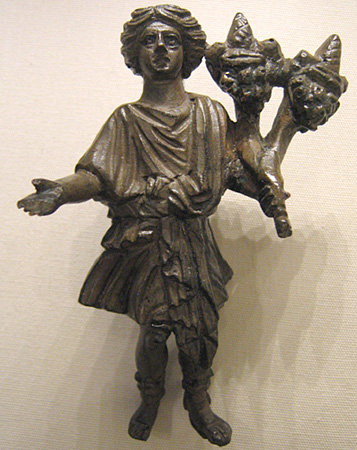
Bronze Lar Figurine
Roman, 1st-4th century CE. London, British Museum


A manus or the manes (plural) were chthonic deities ( deities of the earth or underworld [chthonic] who were usually sacrificed dark animals as opposed to air deities [Olympian] who were offered light colored animals) that were closely resembled of the Lares or household deities. Martianus Capella (De nuptiis Philologiae et Mercurii  Book II, Chapter 164) thought that Summanus was simply another name for Pluto.


Pluto who was the Roman equivalent to Hades was lord of the Underworld and brother of Jupiter (or Zeus). Jupiter traditional being the king of the gods and the male supreme god of the air, ethereal region, and sun. While, Pluto resigned in Hades where he reigned in darkness.

Pluto/Hades with Cerberus
Herkalion Archaeological, Crete
 

Thus the correlation between Pluto and Summanus at Monte Sumano may not be coincidental. Agreeing with Capella, Summanus simply may be a different aspect of Pluto- lightning- which may have been evolved from the duality of the light/day brother versus the dark/night brother.

Summanus Festival: June 20th
 
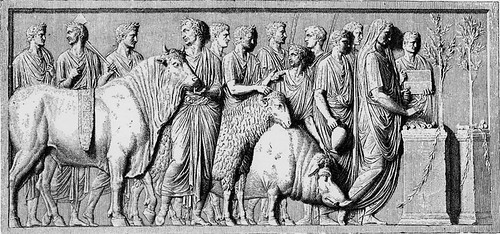
Ancient Roman Festival and Offering Sacrifices
 
 It is said that on this day round cakes in the shape of wheels were offered to Summanus along with two dark oxen (since he is considered a chthonic deity). The round cakes were usually made from flour, milk, and honey. The wheel has often been argued by scholar to be a solar symbol. However, it is unclear as to why a nocturnal lightning god would relish in solar symbolic cakes.
 
An Example of a Round Cake that may be offered; perhaps
even glazed with honey.
There is one solution to this contradiction: Pettazzoni offers in his essay on "The Wheel in Ritual Symbolism of Some Indo-European Peoples" that the festival was actual celebrated on June 20th, because it was the natalis or birthday of his temple built by Circus Maximus.
 
Carbonized Bread from Pompeii 1st AD
*Perhaps, this would resemble our wheel round cake
 
Pompeii frescoes, 1st c. C.E
Another Example of a Summanlia
 
Thus the wheel cakes known as summanalia are not in reference to the deity himself, but the time of year. June 20th is the day before the Summer Solstice . The Summer Solstice being the longest day of the year.
 
Diagram of the Solstices and Equinoxes

Although this last image is Egyptian, I believe it reflect the universal theme of round cakes being offered to deities from 2000's BCE all the way to St. Augustine in 350's CE!
 
Offering Case For A Round Cake
Egyptian, Old Kingdom, Dynasty 6, 2323–2150 B.C
 
    Finally, it should be noted that festival for any deity no matter how small or new they were taken seriously. There were taken seriously by those who were pious and fearful of the gods, and by those who wanted to party and have a great barbeque. Sometimes, the animals that were sacrificed after having been killed were eaten by the attendees of the festival and celebration. In modern day, many of us can relate with our various patriotic holidays that somehow call for us to bbq- perhaps this is where the tradition comes from!


BBQ


*The Pyrrhic War occurred  roughly 270 BC.