The Lovers' Coin: A Rare Discovery
of a Mark Antony and Cleopatra Bronze Coin
 |
| Antony and Cleopatra by Lawerence Alma- Tadema; Courtesy of WikiCommons |
The story of Marc Antony and Cleopatra is a
love story of seduction, exotic locations, love-triangles, family, politics,
war, and suicide. More importantly, their love affair was connected to the rise
and fall of the Roman and Egyptian empire. It is easy to see how their love affair
is intriguing tale for centuries worth of audiences from Plutarch's portrayal
to Elizabeth Taylor's role to HBO's Rome Series. While there are countless of
images produce of their romantic and tragic life; there something extraordinary
in contemporary pieces that show both couples.
A recent archaeological discover in Tel
Bethsaida (Northern coast of the Sea of Galilee)
yielded a coin with the images of these notorious lovers.
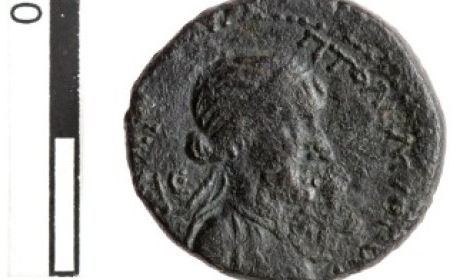
The Cleopatra and Antony
side of the coin. Hanan Shafir. Courtesy of the Bethsaida Excavations Project
This coin found in Tel Bethsaida was actually
minted in the
port of
Akko (known today as
Acre).
The coin is made of bronze, is approximately the size of a quarter (21-23
millimeters in diameter). It was minted in the last half of 35BCE and/or the
first half of 34BCE.
An side
image of the Cleopatra side with a parallel image of the Greek letters
outlined.
Cleopatra's side of the coin, it is somewhat unclear in the photo above, but
one can see the Greek word: ΠΤΟΛΕΜΙδΣ .
This is the genitive form of the noun Ptolemais which means: "of the
people of Ptolemais."
Ptolemais is the name for ancient Akko, which
was founded by Ptomlemy II Philadelphus in the 3rd century BCE.
"The cities of the ancient Middle East
had a habit of minting coins bearing the portraits of whoever was in power,"
says Dr. Ariel, head of Israel Antiquities Authority Coin Department.
In
35 BCE,
Antony's recent victory over the
Parthians(Northeast Iran and
Armenia),
and his bestowing
Armenia to
Cleopatra's sons and
Cyprus
to her daughter may indicate why the ancient
Middle East
considered him powerful.
Dating the coin was an interesting journey. Dr. Arav of the Bethsaida Excavations Project said the dating system was difficult to find. He continued to explain to me through our email conversations: On the Cleopatra side of the coin, there is a small I (iota) and E (epsilon). The Greek alphabet goes as follows : A=1, B=2, Γ=3, Δ=4, and so on. Thus, I and E in their numbering system are 10 and 5 respectively. Therefore, the I and E means 15.
However, what does the 15 mean? Dr. Arav explained that book research was essential in the following discovery: The people of Ptolemais valued greatly the event of Julius Caesar visiting the area to rid their waters of pirates. This event happened in 49BCE, the people of Ptolemais therefore used their dating system in reference to 49BCE. Thus, 49BCE being the starting date, 15 years later would be 35-34 BCE.
Dr. Ariel said, "Coins with the portraits
of
Antony and
Cleopatra are extremely rare. Only six have been found anywhere in the world.
"
However according to the ancient numismatic reference site Wildwinds.com,
there have been more than six discoveries of
Antony and Cleopatra coins.
Though, it would stand that only six of the eight coins are in good condition.
This coin would make the seventh. However, it has to be asked if the ancient
Middle East considered
Antony
and Cleopatra powerful in 35 BCE (and perhaps other years as well); why are
there not more of these "lovers' coin?"
 |
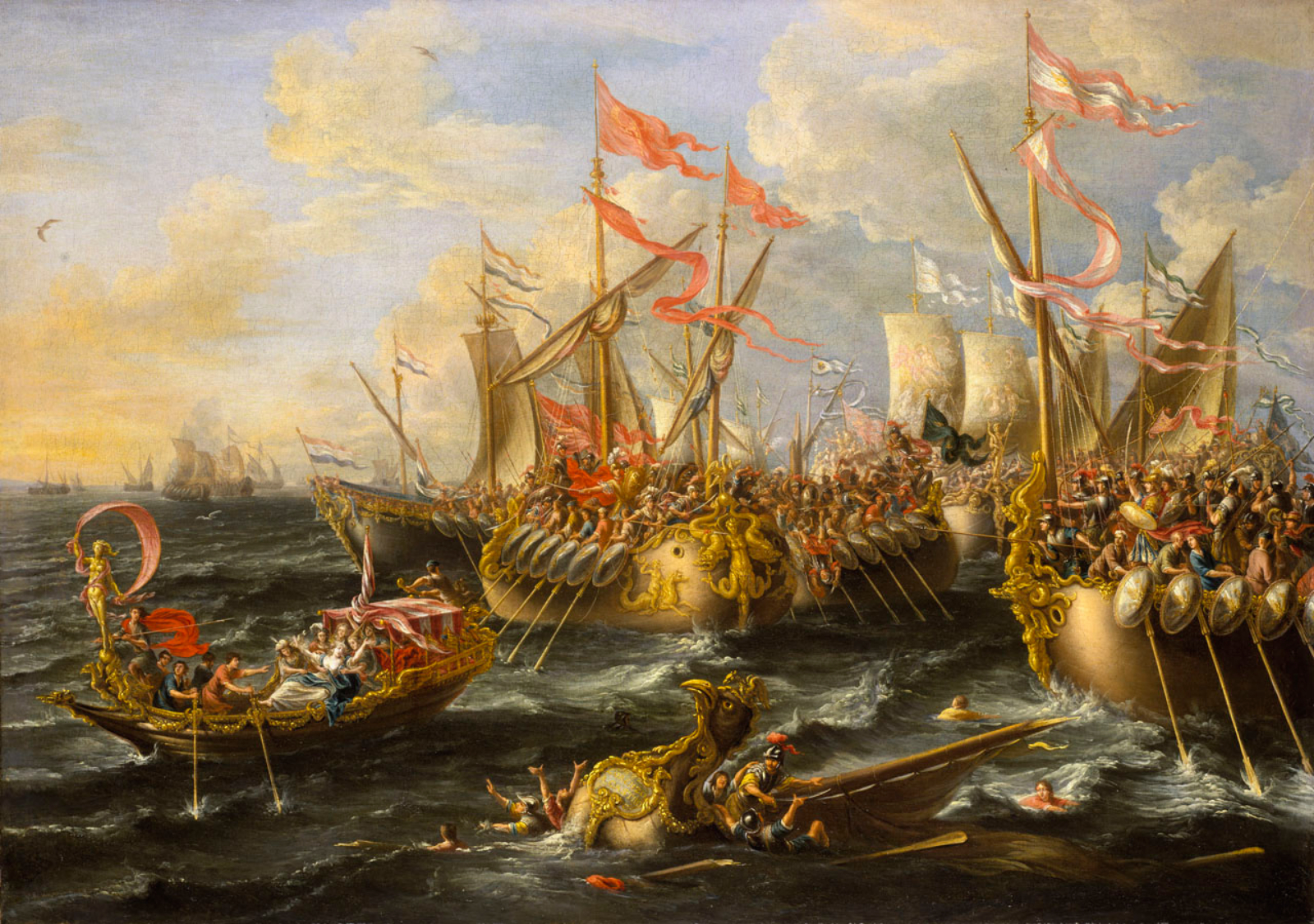
The Battle of Actium 2, September 31BC by Lorenzo A. Castro
Courtesy of Wikicommons
|
However, it is not difficult to hypothesize
that Augustus Caesar may have had them collected and destroyed after his
victory at Actium. Augustus after all did destroy
Antony's portraits after his death, but for some
reason allowed Cleopatra's statues to remain in Caesar's Temple to Venus Genetrix.
Perhaps, Augustus admired Cleopatra that as a foreigner her ambition, cunning,
and wit were understandable However, his unforgiving attitude towards Antony may have had to do
with his sister Octavia. Antony's affair with
Cleopatra was at the expense of Augustus's sister and Antony's wife Octavia and their children.
Cleopatra as a foreigner was understood to be less than a respectable being,
but as a Roman male citizen Antony's
actions were inexcusable.
 |
| Silver denarius of Cleopatra VII and Mark Antony , 30's BCE. Courtesy of the British Museum |
It is these rare coins which provide a look
into
Antony's
and Cleopatra's policy of their portrayal, features, and idealized form. It is
uncertain whether they wish to emulate a certain presence, as is suggested by
the
British Museum,"
Antony was said to remind people of the Greek
hero Herakles in paintings and sculptures, with '... a very good and noble
appearance; his beard was not unsightly, his forehead broad, and his nose
aquiline' (Plutarch, Life of Antony, 4). However, here his portrait
seems to have picked up Ptolemaic features, specifically the strong projecting
chin of Ptolemy I, the founder of Cleopatra's dynasty, and the hooked noses of
Cleopatra and her father Ptolemy XII."
Thus, this
infamous couple continues to engage, fill, and plague our minds. Though, they
are long dead and their story known by most; they continue to be the topic of
much discussion, debate, and obsession.
~~~~~~~~~~~~~~~~~~~~~~~~~
Main Sources & Contributors:
Private Correspondence with Dr. Arav
The ancient coin of Cleopatra:
There could have been pyramids in Paris
By Miriam
Feinberg Vamosh | Aug. 4, 2013 |http://www.haaretz.com/archaeology/.premium-1.539712
1. Israel Antiquities Authority
Coin Department
2. The Bethsaida Excavations Project
Secondary Sources &
Contributors:
British Museum:
http://www.britishmuseum.org/explore/online_tours/egypt/cleopatra_history_to_myth/denarius_of_cleopatra__antony.aspx
Liddell and Scott,
Greek-English Lexicon
,Oxford University
Press, 1996
The Cambridge Companion
to the Age of Augustus/edited by Karl Galinsky.Cambridge University Press, 2005
Plutarch, Life of Antony, Cambridge
University Press, 1988.
Vamosh, "The ancient coin of Cleopatra: There
could have been pyramids in Paris"
|http://www.haaretz.com/archaeology/.premium-1.539712
The Cambridge Companion to the Age of Augustus/edited
by Karl Galinsky.Cambridge University Press, 2005
British Museum:
http://www.britishmuseum.org/explore/online_tours/egypt/cleopatra_history_to_myth/denarius_of_cleopatra__antony.aspx